
By: Raj Bhatti, Partner, Humanis Executive Search
As a business grows, so too do its finance leadership needs. The focus may begin with getting the numbers right and building discipline, but over time it expands into forecasting, decision support, capital strategy, and broader organizational leadership. The challenge is knowing when the business needs a different level of finance leadership, and what that should look like.
A recent Forbes article by Jack McCullough, The CFO Who Got You Here Won’t Get You There, looks at this evolution through four stages: Doer, Builder, Strategist, and Enterprise Leader. It’s a useful framework, and one that closely reflects what I see in both Executive Search and Fractional Search.
The progression is clear, but for many organizations, what’s less obvious is when to make the shift, what kind of leader is needed, and whether that person needs to be permanent, fractional, or something in between. That becomes clearer when you look at how the finance mandate changes at each stage.
- Doer: Finance is focused on execution. Accurate reporting, cash management, compliance, and financial discipline are the priorities.
- Builder: More structure is required. Systems need to improve, processes need to scale, and the finance function needs to become less dependent on one person.
- Strategist: Finance becomes more connected to the decisions shaping the business. Forecasting, capital allocation, performance, financing, and business planning take on greater importance.
- Enterprise Leader: The CFO operates well beyond the finance function, working closely with the CEO and board and contributing to strategy across the organization.
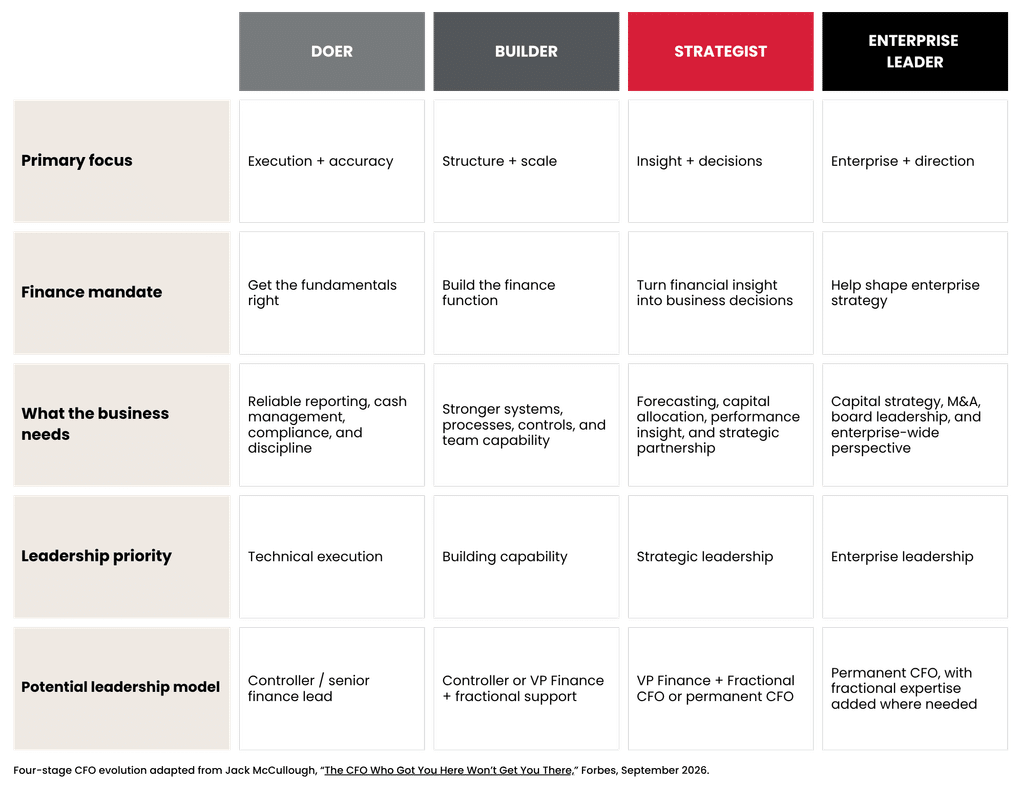
These stages are helpful, but real businesses rarely move through them in a straight line. While revenue matters, it’s only one part of the picture. Complexity, ownership structure, financing requirements, acquisitions, systems, and the strength of the existing finance team can all change what the business needs from its finance leadership.
Don’t start with the title. Start with the mandate.
This is where organizations can get caught up in titles. A business may believe it needs a CFO when the real requirement is a strong VP Finance. Another may already have a capable Controller who understands the business well, but the CEO needs more senior strategic support around financing, growth, or planning. In other cases, the organization has reached the point where a permanent CFO is the right next step.
We explored a similar idea recently with fractional CFO and executive advisor Shawn McMillan as part of our Humanis Leadership Interview Series. Shawn described a similar progression in finance leadership, from the foundational work of a Bookkeeper through the increasing responsibilities of a Controller and VP Finance, and ultimately to the broader strategic role of the CFO. His point was that organizations need to be clear about what they actually require rather than starting with the title.
I see the same thing in search. Before defining the role, we need to understand the work. What decisions need stronger financial input? Where is the current team strong? Where are the gaps? What is changing in the business over the next 12 to 24 months?
The answers help define the level of finance leadership required and the best way to access it.
Fractional CFOs can support more than one stage
Fractional CFOs are often associated with smaller businesses that need senior finance expertise but are not ready for a full-time CFO. That is still an important use case, but it’s only one.
A Fractional CFO can help an organization strengthen systems, forecasting, and financial discipline as it moves from execution into a more structured finance function. They can work alongside a Controller or VP Finance, adding senior-level perspective without replacing a strong internal leader.
They can also support a business through a defined period of change. An acquisition, financing event, restructuring, ownership transition, or rapid growth can create a need for CFO-level experience without necessarily creating a permanent role.
Fractional leadership can also provide a bridge to a permanent hire. In that situation, the Fractional CFO can stabilize the function, help clarify the long-term mandate, and give the organization time to conduct a thoughtful Executive Search.
Fractional and permanent leadership should not be viewed as competing models. They solve different problems, and in some cases, they work best together.
Knowing when permanent finance leadership is the right next step
There also comes a point where a permanent CFO becomes the stronger fit. The business may need someone fully embedded in the organization, developing the team, building relationships across functions, and carrying long-term accountability for the finance mandate. The role may also be expanding into areas such as capital strategy, transformation, technology, M&A, or board-level leadership.
I have written previously about how much the CFO mandate has changed. Today’s CFO is increasingly expected to combine financial depth with broader business judgement, technology awareness, and leadership across the enterprise.
For some organizations, that level of responsibility requires a permanent executive. For others, it may still make sense to access that expertise on a fractional basis while the business continues to evolve. The key is understanding which situation you are in.
The finance leadership model should follow the need
Finance leadership no longer has to follow one fixed path. An organization may develop an existing leader, add a Fractional CFO, bring in interim support, or recruit a permanent CFO. Each can be the right decision at the right time.
The starting point should be the same: define the mandate before defining the model. McCullough’s four-stage framework offers a useful way to think about how finance leadership evolves from Doer to Builder to Strategist to Enterprise Leader. The real value, though, comes from understanding where your business is today and what it will need next.
That is a better question than simply asking whether it is time to hire a CFO. The more useful question is: What does our business need from finance leadership next?